Choosing the right office space can make or break your business operations. As companies evolve and adapt to changing work patterns, understanding the fundamental differences between serviced and traditional office spaces becomes crucial for making informed decisions about your workplace strategy.
Both options offer distinct advantages, but they cater to different business needs, budgets, and growth trajectories. Whether you’re a startup seeking flexibility or an established company looking for long-term stability, the choice between serviced and traditional office space will significantly impact your operational costs, team productivity, and business agility.
What is a serviced office and how does it work?
A serviced office is a fully furnished workspace that includes utilities, internet, reception services, and maintenance as part of a single monthly fee. Providers handle all operational aspects, from cleaning and security to phone systems and meeting room access, allowing businesses to move in immediately without setup costs or long-term commitments.
The serviced office model operates on flexibility and convenience. Most providers offer month-to-month agreements or short-term leases, making it easy for businesses to scale up or down as needed. The space typically includes professional reception services, shared amenities like meeting rooms and kitchen facilities, and technical support for IT infrastructure.
Key features of serviced offices include:
- Fully furnished workspaces with desks, chairs, and storage
- High-speed internet and phone systems included
- Shared facilities such as meeting rooms, break areas, and printing stations
- Reception and administrative support services
- Flexible lease terms ranging from monthly to annual agreements
- All-inclusive pricing covering utilities, cleaning, and maintenance
This model particularly appeals to businesses that want to focus entirely on their core operations without worrying about office management tasks. The provider takes responsibility for everything from replacing light bulbs to managing security systems, creating a turnkey solution for companies seeking operational simplicity.
What’s the main difference between serviced and traditional office spaces?
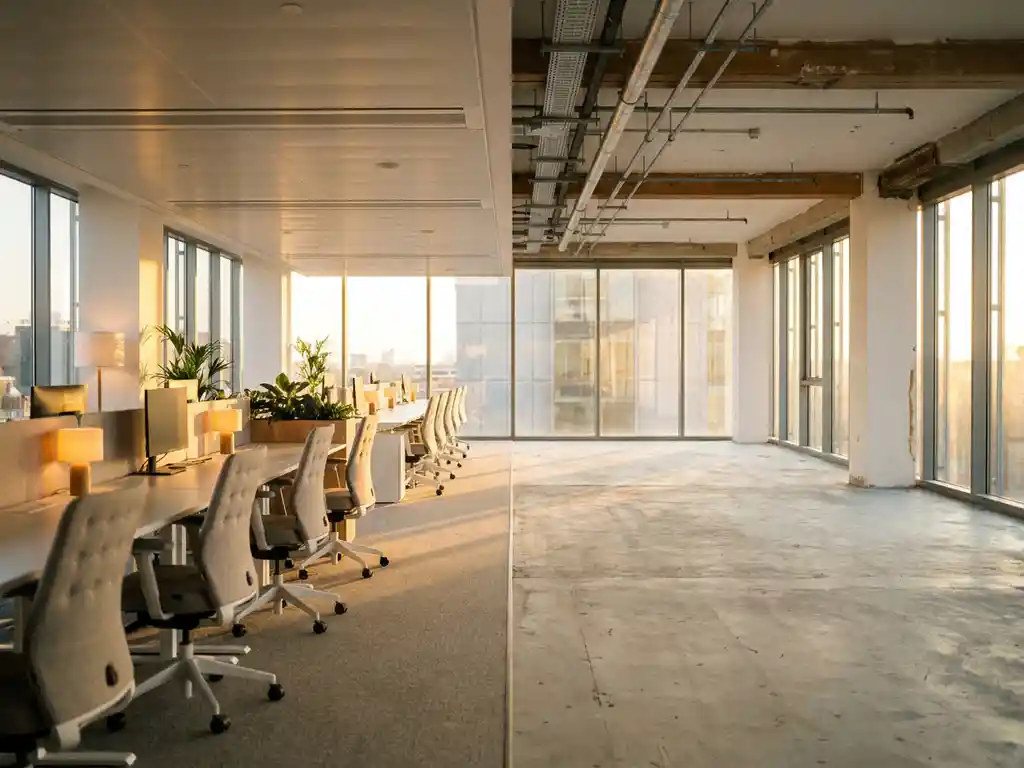
The primary difference lies in responsibility and flexibility: serviced offices provide all-inclusive, managed workspaces with short-term commitments, while traditional offices require businesses to handle setup, utilities, and maintenance themselves under long-term lease agreements typically lasting three to ten years.
Traditional office spaces come as empty or basic shells where tenants must invest in furniture, internet infrastructure, phone systems, and ongoing maintenance. This approach offers complete control over the workspace design and operations but requires significant upfront investment and ongoing management responsibility.
The key distinctions include:
Lease flexibility: Serviced offices offer monthly or short-term agreements, while traditional spaces typically require multi-year commitments with personal guarantees and substantial security deposits.
Setup requirements: Serviced offices are move-in ready, whereas traditional spaces need a complete fit-out including furniture, technology infrastructure, and utility connections.
Operational responsibility: In serviced offices, the provider manages all facilities, while traditional tenants handle everything from cleaning contracts to equipment maintenance.
Cost structure: Serviced offices bundle all costs into one monthly fee, while traditional spaces involve separate payments for rent, utilities, insurance, maintenance, and services.
Customization level: Traditional offices allow complete design freedom and branding opportunities, while serviced spaces typically offer limited customization within pre-designed environments.
How much do serviced offices cost compared to traditional spaces?
Serviced offices typically cost 20-50% more per square meter than traditional office space on a monthly basis, but they eliminate upfront costs like furniture, deposits, and fit-out expenses that can range from €200-500 per square meter for traditional spaces.
The cost comparison becomes more complex when examining the total investment over time. Traditional office spaces require substantial initial capital for setup, including:
- Security deposits equivalent to 3-6 months’ rent
- Furniture and equipment purchases
- IT infrastructure installation
- Utility connection fees and deposits
- Legal fees for lease negotiations
For a 100-square-meter traditional office space, initial setup costs can easily reach €25,000-50,000 before accounting for ongoing operational expenses like cleaning, maintenance, and utility bills.
Serviced offices eliminate these upfront investments but charge premium monthly rates. A typical serviced office might cost €25-40 per square meter monthly, while comparable traditional space might rent for €15-25 per square meter plus additional operational costs.
However, the break-even point varies significantly based on occupancy duration. For commitments under 18 months, serviced offices often prove more economical when factoring in setup costs and operational flexibility. For longer-term occupancy beyond three years, traditional spaces typically offer better value despite higher initial investment.
Which type of office space is better for growing businesses?
Growing businesses benefit most from serviced offices during early expansion phases due to their flexibility and scalability, allowing companies to adjust space requirements quickly without lease penalties or costly relocations as team sizes fluctuate.
The unpredictable nature of business growth makes flexibility paramount. Serviced offices accommodate this uncertainty by offering:
Scalable solutions: Most providers allow businesses to add or reduce desk spaces with minimal notice, supporting both rapid hiring and potential downsizing without financial penalties.
Geographic flexibility: Many serviced office providers operate multiple locations, enabling businesses to establish a presence in new markets or relocate operations without complex lease negotiations.
Cash flow preservation: By eliminating large upfront investments, growing businesses can allocate capital toward core growth activities like product development, marketing, and talent acquisition rather than office infrastructure.
Professional image: Serviced offices typically offer prestigious addresses and professional reception services that enhance credibility with clients and partners, crucial for growing companies establishing market presence.
However, established businesses with predictable space requirements and long-term location commitments may find traditional offices more cost-effective. Companies planning to occupy the same space for over three years, requiring extensive customization, or needing specialized facilities often benefit from traditional lease arrangements despite higher initial investment.
The decision ultimately depends on growth predictability, capital availability, and operational priorities. Fast-growing startups and companies entering new markets typically thrive in serviced environments, while mature businesses with stable requirements may prefer the control and cost savings of traditional spaces.
How FIRST Real Estate helps you find the right office space
We specialize in helping businesses navigate the complex decision between serviced and traditional office spaces by providing expert market analysis and personalized recommendations based on your specific growth trajectory and operational needs.
Our comprehensive approach includes:
- Detailed cost-benefit analysis comparing serviced versus traditional options for your situation
- Market insights on availability, pricing trends, and location advantages across the Netherlands
- Negotiation support for both serviced office agreements and traditional lease contracts
- Space planning guidance to optimize your chosen office layout for productivity and growth
- Ongoing portfolio management as your space requirements evolve
Whether you’re a growing startup seeking flexibility or an established company planning long-term expansion, we provide the expertise needed to make informed office space decisions that support your business objectives. Contact us today to discuss your office space requirements and explore our comprehensive services designed to find the perfect workspace solution for your business.
Benieuwd wat FIRST Real Estate voor uw vastgoed kan betekenen?
Onze specialisten denken graag met u mee over uw vastgoedvraagstuk en de mogelijkheden die daarbij passen.
Gerelateerde artikelen
- Wat is het verschil tussen een flexibele kantoorruimte en een vaste huurlocatie voor werkgeluk?
- Hoe beïnvloedt werkgeluk het imago van een bedrijf als werkgever?
- Hoe vind je betrouwbare verhuurmakelaars Amsterdam?
- Hoe vind ik betaalbare kantoorruimte als startup?
- 7 checklist items voordat je kantoorruimte gaat huren