
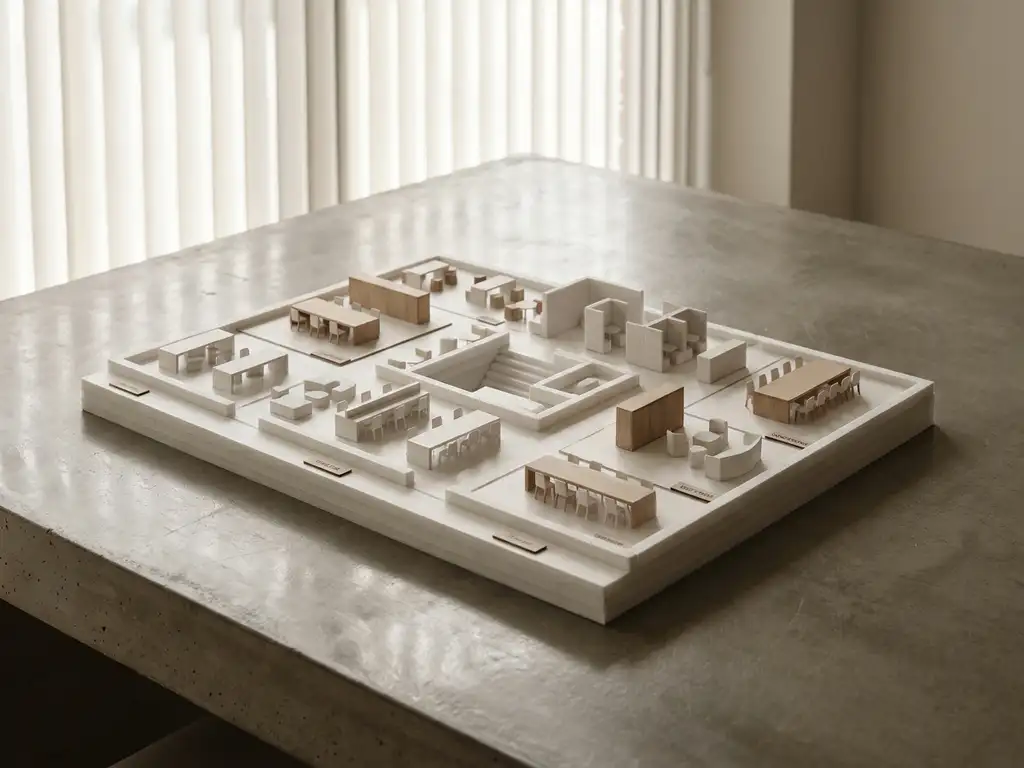
Creating an efficient office space layout is crucial for maximizing productivity, employee satisfaction, and business success. A well-designed office environment directly impacts how teams collaborate, how individuals focus, and how efficiently daily operations flow. Whether you’re planning a new office from scratch or optimizing your current space, understanding the principles of effective office design will help you create a workspace that supports your business goals and enhances employee well-being.
The modern office has evolved significantly, with businesses recognizing that thoughtful space planning goes beyond simply fitting desks into a room. Today’s efficient office layouts balance productivity needs with collaboration requirements, incorporate flexibility for changing work patterns, and prioritize employee comfort and health.
What makes an office space layout efficient?
An efficient office space layout maximizes productivity while minimizing wasted space and movement. It strategically positions different work zones to support natural workflow patterns, reduces distractions, and creates clear pathways for communication and collaboration.
Several key elements define efficiency in office design. First, the layout should support the specific work processes of your organization. Teams that collaborate frequently should be positioned near each other, while employees requiring deep focus benefit from quieter, more secluded areas. Natural light distribution plays a crucial role, with workstations positioned to take advantage of windows while avoiding glare issues.
Traffic flow represents another critical efficiency factor. Well-planned offices minimize unnecessary movement by placing frequently used resources like printers, meeting rooms, and break areas in accessible locations. The 80/20 rule often applies here: 80% of daily activities should require minimal movement within the space.
Flexibility also contributes significantly to efficiency. Modern businesses change rapidly, and office layouts should accommodate growth, team restructuring, and evolving work styles without requiring complete redesigns. This might involve modular furniture systems, movable partitions, or multipurpose spaces that serve different functions throughout the day.
How do you plan an office space layout from scratch?
Planning an office layout from scratch begins with analyzing your workforce needs, work processes, and company culture. Start by conducting a thorough assessment of how many employees need space, what types of work they perform, and how they interact throughout the day.
The planning process follows several sequential steps:
- Space audit and requirements gathering: Measure the available space and identify structural elements like columns, windows, and utility connections. Simultaneously, survey employees about their work habits, collaboration needs, and space preferences.
- Functional zoning: Divide the space into distinct zones based on activity types. Common zones include focused work areas, collaborative spaces, meeting rooms, social areas, and support functions like storage and printing.
- Traffic pattern mapping: Plan primary and secondary circulation routes that connect different zones efficiently. Consider both planned movement (going to meetings) and spontaneous interactions.
- Furniture and equipment placement: Position workstations, meeting tables, and equipment based on the zoning plan while considering factors like natural light, acoustics, and power access.
- Technology integration: Plan for current and future technology needs, including power outlets, data connections, wireless coverage, and audio-visual equipment in meeting spaces.
Throughout this process, involve key stakeholders and potential users in the planning discussions. Their insights about daily work patterns and pain points with previous office layouts provide valuable guidance for creating a truly functional space.
What are the different types of office layout designs?
Office layout designs fall into several distinct categories, each offering different advantages for productivity, collaboration, and cost efficiency. The most common types include open plan, private offices, hybrid layouts, and activity-based working environments.
Open plan offices feature large, unpartitioned spaces where employees work at individual desks or workstations. This design promotes collaboration and communication while maximizing space efficiency and reducing construction costs. However, open plans can create noise distractions and limit privacy for focused work.
Private office layouts provide individual enclosed spaces for each employee or small teams. These designs offer maximum privacy and noise control, making them ideal for roles requiring deep concentration or confidential conversations. The trade-off includes higher construction costs and potentially reduced spontaneous collaboration.
Hybrid layouts combine elements of both open and private designs, creating varied spaces within the same office. This approach might include open collaboration areas, private offices for senior staff, and semi-private workstations with partial partitions. Hybrid designs offer flexibility to accommodate different work styles and roles.
Activity-based working (ABW) represents a modern approach where employees choose from various work settings based on their current task. ABW offices include quiet focus zones, collaborative project areas, phone booths for calls, and casual meeting spaces. This design requires fewer total workstations than traditional layouts since not all employees need dedicated desks.
How much space do you need per employee in an office?
The standard space allocation per employee ranges from 150 to 250 square feet in traditional office settings, though modern flexible layouts often reduce this to 100-150 square feet per person. The actual space requirement depends on job functions, collaboration needs, and the chosen layout design.
Space calculations must account for both individual workstations and shared areas. A typical breakdown includes:
- Individual workstation: 50-75 square feet for desk, chair, and immediate personal storage
- Circulation and pathways: 20-30% of total space for movement between areas
- Meeting and collaboration spaces: 15-25% of total space, depending on company culture and work style
- Support areas: 10-15% for reception, break rooms, storage, and utility functions
Different roles require varying space allocations. Executive offices typically need 200-400 square feet, while call center workstations might function effectively in 50-75 square feet. Creative roles often benefit from larger spaces that accommodate project materials and collaboration tools.
The trend toward flexible and remote work has reduced space requirements for many organizations. Hot-desking and activity-based working can reduce space needs by 20-40% compared to traditional assigned seating, as these models account for employees who work remotely part-time or travel frequently.
How do you optimize office layout for productivity and collaboration?
Optimizing office layout for productivity and collaboration requires balancing individual focus needs with team interaction opportunities. Create distinct zones for different work modes, position collaborative spaces strategically, and minimize distractions in focus areas while encouraging natural interaction in common areas.
Successful optimization strategies include:
Acoustic design: Use sound-absorbing materials, white noise systems, or natural sound barriers to create appropriate noise levels for different zones. Quiet areas need minimal ambient sound, while collaborative spaces can accommodate higher activity levels.
Visual connections: Design sight lines that allow managers to stay connected with their teams while enabling employees to see when colleagues are available for impromptu discussions. Glass partitions and low-height workstation panels facilitate visual connectivity without sacrificing all privacy.
Proximity planning: Position frequently collaborating teams within easy walking distance of each other. Place shared resources like printers and supplies in central locations that serve multiple teams efficiently.
Flexibility features: Incorporate movable furniture, modular partitions, and multipurpose spaces that can be reconfigured for different projects or team sizes. This adaptability supports changing collaboration needs without requiring major renovations.
Technology integration: Ensure collaborative spaces have appropriate technology support, including wireless presentation capabilities, video conferencing equipment, and sufficient power outlets for personal devices. Poor technology infrastructure can significantly hinder collaboration effectiveness.
How First Real Estate helps with office space optimization
We understand that finding and designing the perfect office space requires specialized expertise in both real estate and workplace strategy. Our team combines deep market knowledge with practical experience in office space planning to help businesses create efficient, productive work environments.
Our comprehensive approach to office space optimization includes:
- Space needs assessment: We analyze your current and projected workforce requirements to determine optimal space allocation and layout strategies
- Location scouting: Our market expertise helps identify properties that offer the right combination of space, location, and flexibility for your business needs
- Layout consultation: We provide guidance on space planning principles that maximize both productivity and cost efficiency
- Lease negotiation: Our experience ensures you secure favorable terms that support your long-term office space strategy
- Future-proofing advice: We help plan for growth and changing work patterns to avoid costly relocations or renovations
Whether you’re planning a new office from scratch or optimizing your current space, our expertise in commercial real estate and office design ensures you make informed decisions that support your business success. Contact us to discuss how we can help you create an efficient office space that enhances productivity and supports your team’s success. Learn more about our comprehensive services and discover how we can transform your office space vision into reality.
Benieuwd wat FIRST Real Estate voor uw vastgoed kan betekenen?
Onze specialisten denken graag met u mee over uw vastgoedvraagstuk en de mogelijkheden die daarbij passen.
Gerelateerde artikelen
- Hoe vergelijk je verschillende kantoorgebouwen op energieverbruik en duurzaamheid?
- Hoe vergelijk je verschillende kantoorruimtes in Amsterdam?
- Hoeveel ruimte heeft een team van 20 mensen nodig?
- Wanneer moet je een bureaustoel vervangen?
- Welke kostenbesparingen levert hybride werken op bij het huren van kantoorruimte?